A Code Scan Is Not a Diagnosis: What Advanced Vehicle Diagnostics Actually Means
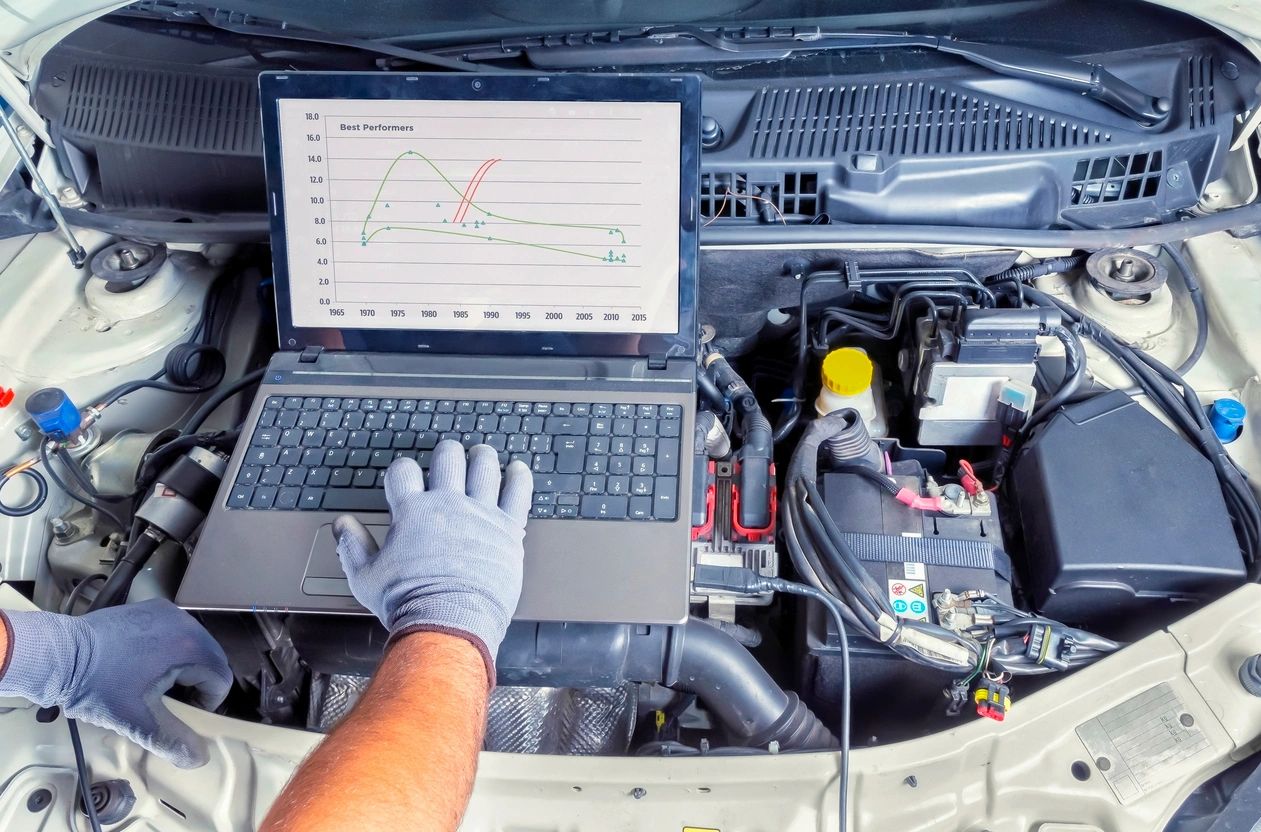
Your check engine light comes on. Someone plugs in a scanner and tells you it says you need an oxygen sensor. So you replace the oxygen sensor. The light comes back.
What Does a Code Scanner Actually Tell You?
Modern vehicles contain computers that continuously monitor different systems throughout the vehicle. When the computer recognizes information outside its expected range, it may store a diagnostic trouble code and illuminate a warning light.
That code tells the technician what the vehicle noticed. It does not always tell us why it happened.
For example, a misfire code identifying a particular cylinder tells us that the vehicle detected a misfire there. That does not automatically mean "Replace the ignition coil." The underlying problem could involve ignition, fuel delivery, wiring, compression, air, mechanical condition, or another issue affecting combustion.
Likewise, a trouble code involving an oxygen sensor does not automatically prove that the oxygen sensor itself has failed. The sensor may simply be accurately reporting a problem happening in the system connected to that component. That's where actual diagnostics begin.
Parts Stores Can Scan Codes. Diagnosis Goes Further.
Many auto-parts stores will scan a check engine light at no charge. That can be useful. If what you need is the trouble code stored by the vehicle, there's nothing wrong with getting that information.
But there is an important difference between retrieving a code and determining the cause of the problem. Advanced vehicle diagnostics can involve combining multiple pieces of information: your description of what the vehicle is doing, when and under what conditions the problem occurs, diagnostic trouble codes, live vehicle data, electrical testing, wiring and connector inspection, sensor readings, mechanical testing, visual inspection, system-specific testing, and the relationship between several seemingly unrelated symptoms.
Sometimes the answer is straightforward. Sometimes the first clue leads somewhere entirely different. And sometimes the diagnostic process prevents a perfectly good — and expensive — part from being replaced unnecessarily.
The "Parts Cannon" Gets Expensive Fast
There is a phrase mechanics sometimes use for repeatedly replacing components based on what might be wrong: firing the parts cannon. Replace the most obvious part. Still broken? Replace the next likely part. Still broken? Try another.
There are circumstances where a technician has to work through possibilities, particularly with intermittent problems. Automotive diagnosis isn't magic, and vehicles don't always fail neatly. But replacing components without first gathering enough evidence can turn the customer into the one financing the troubleshooting process. We don't think that's a good approach.
Frank has spent nearly three decades learning how vehicle systems work — not only repairing them, but tearing them down, rebuilding them, and seeing how their individual components interact. His experience ranges from years dismantling and parting out vehicles to professional work with Harley-Davidson, Jensen, Volvo, and Toyota. He holds five ASE certifications, including A6 Electrical/Electronic Systems and A1 Engine Repair, and also rebuilds engines and transmissions rather than limiting his work to component replacement.
Good Diagnostics Start With the Problem You Actually Have
One of the most useful diagnostic tools isn't plugged into the vehicle at all. It's you. You know what your vehicle normally feels like.
You may know that the problem only happens on cold mornings, it starts after you've driven for 20 minutes, the vibration appears around a particular speed, the vehicle struggles only under acceleration, the air conditioning works until you're sitting in traffic, the battery keeps dying even though it was recently replaced, the warning light appears intermittently, or three strange things started happening at approximately the same time. Those details matter.
A good diagnostic process begins by understanding the complaint and, when possible, recreating the condition. From there, the goal is not simply to find a problem. It's to determine whether we've found the problem responsible for what brought you to us.
Electrical Problems Are a Good Example
Modern vehicles rely heavily on electronics. A vehicle can have dozens of computers communicating with one another, miles of wiring, sensors throughout the vehicle, shared grounds, connectors exposed to heat and moisture, and modules that depend on accurate voltage and communication.
That means an electrical problem isn't always solved by replacing whichever electronic component appears in a trouble code. A failed component is certainly possible. But so are damaged wiring, poor connections, corrosion, voltage problems, ground issues, communication faults, blown fuses, damaged connectors, or another system sending information that causes the affected module to react.
This is one of the areas Frank especially enjoys. Among his mechanic friends, he has become a go-to person when someone is facing a difficult problem, needs another perspective, or wants help understanding what the vehicle is actually doing. The puzzle is part of the job.
Older Doesn't Mean Hopeless
Advanced diagnostics also aren't limited to new vehicles with sophisticated computer systems. Mechanical diagnosis matters too. An older car or truck may require a completely different thought process — but understanding engines, transmissions, steering, suspension, brakes, electrical systems, and the way those systems interact is still the foundation.
Frank has a particular soft spot for vehicles other people may have already written off. He still maintains his own beloved '90s truck, so there is no requirement that your vehicle be shiny, new, or worth more than your first house before we'll take it seriously.
Sometimes an older vehicle genuinely isn't economical to repair. When that's the case, we'll tell you. But age alone doesn't mean a vehicle belongs in the junkyard.
Our Diagnostic Service Is $150
Iron Horse Automotive charges $150 for professional diagnostic service per hour. We do not advertise "free diagnostics" because diagnosis is real work. It requires time, equipment, experience, testing, and — often most importantly — the knowledge needed to interpret what those tests are actually telling us.
However, we also don't believe customers who choose us for the resulting repair should feel like we're stacking another charge on top of the work. If Iron Horse Automotive completes the diagnosed repair, the $150 diagnostic charge is waived.
In other words, diagnostics are a $150 standalone professional service. When that diagnostic work leads into a repair that we complete, we don't separately charge you for both. Our goal is to identify the problem accurately enough that you can make an informed decision about what happens next.
Sometimes the Right Answer Is "Not Yet"
Diagnosis isn't only about figuring out what needs to be repaired. Sometimes it also helps determine how urgently it needs to happen. We believe there is an important difference between "This needs to be repaired now" and "This is beginning to wear, but you have some time."
Cars are expensive enough without turning every imperfection into an emergency. If multiple issues exist, understanding which one affects safety, which one is causing the current complaint, and which one can reasonably wait can help a customer prioritize repairs around an actual household budget. That's part of diagnosing the whole situation — not just finding something we could sell.
What Should You Expect From Iron Horse Automotive?
When you contact us about a diagnostic issue, don't worry about knowing the right terminology. You don't need to diagnose the vehicle before calling the person you're hiring to diagnose it.
Tell us what you're experiencing. Tell us what you've noticed. Tell us what's already been replaced or tested, if anything. And if your entire technical description is "It makes a horrible noise over there sometimes" — that's okay too. We'll start there.
Iron Horse Automotive provides appointment-based automotive services throughout the Omaha area, including advanced diagnostics, repair, aftermarket parts installation, performance upgrades, and work on vehicles ranging from newer electronically controlled systems to well-loved older cars and trucks.
Our goal isn't to see how many parts we can put on your estimate. It's to understand what your vehicle actually needs. Because replacing a part is one skill. Knowing whether it needed to be replaced in the first place is another.